
2026 Rebates & Incentives You Might Be Missing
(Federal + state + utility — and how to stack them without leaving money on the table.) If you’ve heard “the big home energy tax credits are gone,” you’re not wrong — but you might be stopping the search too early. In 2026, the savings story shifts from federal tax credits to rebates, especially programs administered by states and utilities. Here’s what’s still available, how it works, and how EcoSquad helps you actually capture the savings (instead of bookmarking 14 tabs and giving up).
The big 2026 change: many federal home energy tax credits ended after 2025
A lot of homeowners still assume the federal home upgrade credits are running like they did in 2023–2025. But under the One, Big, Beautiful Bill Act (OBBB), the IRS states:
25C (Energy Efficient Home Improvement Credit) isn’t allowed for property placed in service after Dec. 31, 2025.
25D (Residential Clean Energy Credit) isn’t allowed for expenditures after Dec. 31, 2025.
What that means in real life: if you’re planning upgrades in 2026, your best “federal” opportunities are mostly rebate programs, not the big homeowner tax credits.
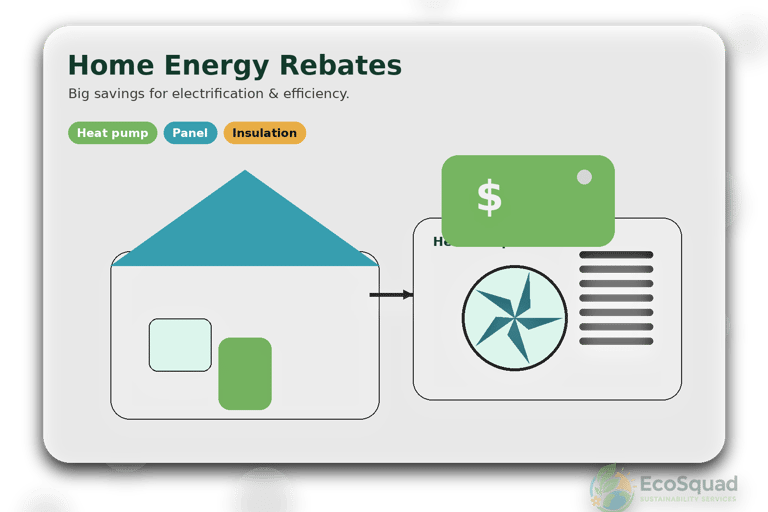
The biggest “federal” savings in 2026: DOE Home Energy Rebates (administered by your state)
Even though these are funded federally, your state runs the program, with state-specific rules and contractor networks. The DOE points people to a portal to check whether their local program is live.
Two rebate tracks (you typically choose one)
HEAR (Home Electrification & Appliance Rebates): aimed at income-qualified households for electrification upgrades.
HOMES / HER (Home Efficiency Rebates): tied to measured or modeled energy savings from whole-home retrofit work.
Common HEAR rebate maximums (what people miss)
DOE’s Home Energy Rebates FAQ fact sheet lists “up to” amounts such as:
$8,000 for an ENERGY STAR–certified heat pump (space heating/cooling)
$4,000 electrical panel
$2,500 electrical wiring
$1,750 heat pump water heater
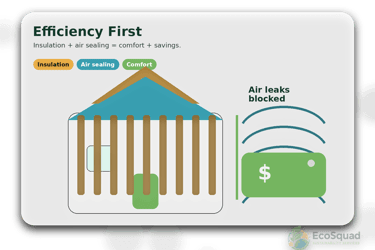
$1,600 insulation / air sealing / mechanical ventilation products
$840 induction/electric cooking equipment (ENERGY STAR–certified where applicable)
Important stacking rule: You generally can’t stack HEAR and HOMES for the same project, and incentives can’t exceed total project cost.
Still a federal incentive in 2026 (for some people): EV charger credit, but on a deadline
If you’re installing home EV charging, pay attention: the 30C credit terminates for property placed in service after June 30, 2026 under OBBB guidance.
Translation: if you’ve been “meaning to install a charger,” 2026 is a use-it-or-lose-it window.
Programs many households forget: Weatherization + bill assistance
These aren’t “rebates” in the retail sense, but for qualifying households they can be the highest-value help available.
Weatherization Assistance Program (WAP)
DOE describes WAP as delivering efficiency upgrades for eligible households and cites average annual savings in a national evaluation.
LIHEAP (energy bill support)
LIHEAP provides help paying heating/cooling costs; eligibility and delivery are state-administered. The federal LIHEAP site offers an eligibility tool.
Utility rebates: the “quiet money” that’s easiest to miss
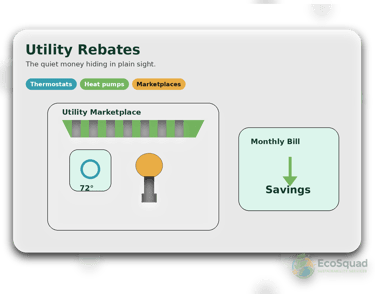
Utilities often offer rebates (or instant discounts through an online “marketplace”) for things like:
smart thermostats
insulation/air sealing
heat pumps / heat pump water heaters
efficient lighting and appliances
demand-response programs (bill credits for letting the utility slightly adjust your thermostat during peak events)
These are hyper-local, which is why they’re so easy to overlook. The ENERGY STAR Rebate Finder is a quick way to see partner rebates by ZIP code.
How to find your 2026 incentives (without losing your weekend)
Here’s the fastest workflow that works in any state:
Step 1 — Check whether your state’s DOE rebates are live
Start at DOE’s Energy Savings Hub and use the Home Energy Rebates Portal to check program status.
Step 2 — Pull a state-by-state list
Use DSIRE to browse incentives and policies by state and technology (it’s one of the most comprehensive U.S. databases).
Step 3 — Search your utility’s rebate page (and marketplace)
If your utility has a marketplace, it may beat retail pricing and “rebates later” paperwork. (This varies heavily by utility.)
Step 4 — Decide your plan: “electrify” vs “whole-home savings”
If you’re swapping equipment (heat pump, panel, induction): HEAR-style path may fit.
If you’re doing insulation + air sealing + HVAC strategy: HOMES/HER may fit.
Step 5 — Don’t violate the fine print
Many programs require:
specific equipment ratings (often ENERGY STAR)
approved contractor participation
pre-approval before work starts
itemized invoices and documentation
How EcoSquad helps you capture the savings (and avoid the “oops, not eligible” trap)
Rebates are great. Rebates + paperwork mistakes are not.
EcoSquad can help households by:
Identifying the best incentives available for your address, utility, and household situation (state + utility + program rules)
Building an upgrade plan that prioritizes the best ROI first (so you don’t spend $5,000 to save $12/year)
Checking eligibility early (income thresholds, equipment requirements, contractor requirements, and “pre-approval before install” rules)
Coordinating documentation (spec sheets, invoices, install dates, certification requirements)
Reducing friction with a simple, guided process so upgrades actually happen
If you want, share your state + your electric utility name and I’ll outline the most likely rebate categories to target first (heat pump, panel, insulation/air sealing, thermostat, etc.) based on what’s typically available in 2026.
Citations
IRS — OBBB home energy credit expirations & termination dates (25C, 25D, 30C, etc.).
https://www.irs.gov/newsroom/one-big-beautiful-bill-provisions
IRS — Instructions for Form 5695 (termination notes).
U.S. Department of Energy — Energy Savings Hub / Home Energy Rebates status portal.
U.S. Department of Energy — Home Upgrades (rebate examples and pathways).
U.S. Department of Energy — Home Energy Rebates FAQ fact sheet (rebate maximums like $8,000 heat pump, $4,000 panel, etc.).
https://www.energy.gov/sites/default/files/2024-12/home-energy-rebates-faq-fact-sheet_925224.pdf
U.S. Treasury — Coordination rules and limitations for DOE rebates (stacking limits).
ENERGY STAR — Rebate Finder (ZIP-based offers).
DSIRE — Database of State Incentives for Renewables & Efficiency.
DOE — Weatherization Assistance Program overview and cited average annual savings.
https://www.energy.gov/scep/wap/weatherization-assistance-program
LIHEAP — Eligibility tool.
Alternative Fuel Data Center — 30C/Alternative Fuel Infrastructure credit timing (through June 30, 2026).




Contact
Get in touch for a greener tomorrow
Phone
© 2025. All rights reserved.
Join EcoSquad
Get tips and updates for greener living.