
Colorado Sustainability Tax Breaks in 2026
What you can claim, what’s shrinking, and how to plan.
SUSTAINABILITYSAVING MONEYTAX BREAKS
Colorado has some of the best state-level incentives in the country for cleaner transportation and home electrification—but 2026 is a “watch your timing” year. State economists have indicated that several “green” discounts/credits (EVs, e-bikes, heat pumps) are expected to be cut in half in 2026, which can change the math on when to buy.
The big 2026 headline
If you’re considering an EV, e-bike, or heat pump, the takeaway is simple:
Incentives are still there in 2026—but some are smaller than 2025.
1) Electric vehicle credit (Colorado Innovative Motor Vehicle Credit)
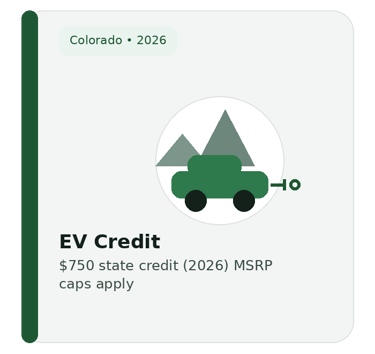
Colorado offers a refundable income tax credit for qualifying new electric and plug-in hybrid electric vehicles (and certain hydrogen vehicles) titled and registered in Colorado. Colorado Department of Revenue
How much in 2026?
For tax year 2026, Colorado’s published credit table shows:
$750 for a qualifying purchase
$750 for a qualifying lease
2) E-bike credit (Colorado Electric Bicycle Credit)
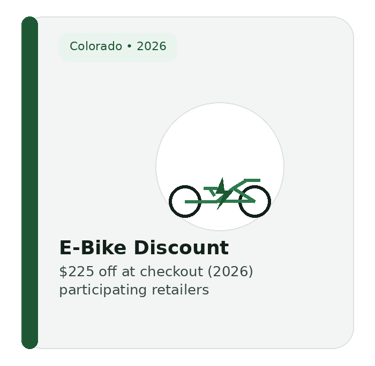
Colorado’s e-bike incentive is designed to be easy for buyers: you receive it as an instant discount at purchase from a qualified retailer (it’s not something most customers “file for” themselves). Retailers must show the discount as a separate line item and may keep an admin fee.
How much in 2026?
Colorado’s official table for the e-bike credit shows for 2026:
Credit: $250
Required discount to the buyer: $225
Admin fee: $25
3) Heat pump “tax credit” (delivered as an invoice discount)
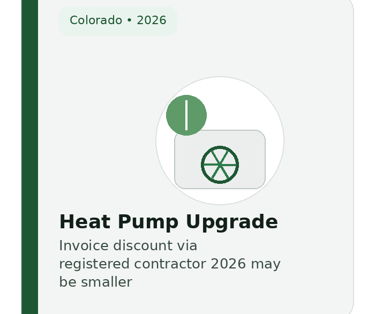
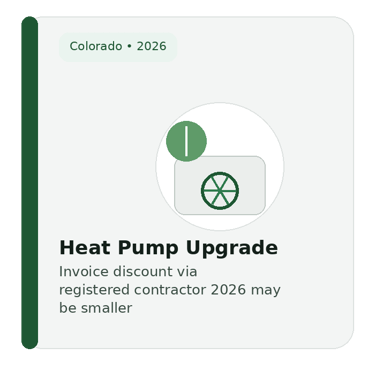
Colorado changed how heat pump incentives work. Starting in 2024, the heat pump tax credit is allowed only to registered contractors, and to earn it, the contractor must provide a discount shown as a separate item on the invoice/receipt.
What the program paid recently (so you understand the scale)
Colorado DOR’s worksheet for registered contractors shows these allowed credit amounts (per “unit,” with rules for how units are counted):
A simple “do this, not that” checklist for 2026
If you want an EV
Confirm it qualifies and note the 2026 base credit is $750.
Check MSRP caps and the under-$35K bonus.
If you want an e-bike
Buy from a qualified retailer so the discount is applied properly and documented.
Expect the 2026 discount to be $225 (smaller than 2024–2025).
If you want a heat pump
Hire a registered contractor and make sure the discount appears as a separate line item on the invoice.
If timing is flexible, know that 2026 is expected to be less generous.
Want to figure out which upgrade will save you the most—and which incentives you actually qualify for?
Book an EcoSquad Tune-Up or Eco Audit and we’ll map out:
your best “quick wins,”
the biggest utility + state savings opportunities,
and the smartest timing for 2026.
Sources
Colorado Department of Revenue — Income Tax Topics: Innovative Motor Vehicle Credit (Revised Nov 2025) Colorado Department of Revenue
Colorado Department of Revenue — Income Tax Topics: Electric Bicycle Credit (Revised Nov 2025) Colorado Department of Revenue
Colorado Department of Revenue — DR 1322 Heat Pump Tax Credit Schedule page Colorado Department of Revenue
Colorado Department of Revenue — DR 1322 (2024) Heat Pump Tax Credit Worksheet Colorado Department of Revenue
The Colorado Sun (June 2025) — report on 2026 “green” credits being cut in half The Colorado Sun



Two key rules people miss
$80,000 MSRP cap: No credit is allowed for vehicles purchased/leased after June 30, 2023 if MSRP is over $80,000.
Under-$35K bonus: An additional $2,500 is available for qualifying vehicles under $35,000 MSRP (within the program’s window).
EcoSquad tip: If you’re shopping EVs, the “best value” zone is often under $35K MSRP, because it can unlock the additional credit.

Heat pump water heater: $500
Air-source / VRF heat pump: $1,500
Ground-/water-/combined-source: $3,000
What’s expected in 2026?
State economists announced the heat pump discounts are expected to be cut in half next year (2026) under Colorado’s forecast trigger.


Federal credits you may stack with Colorado
Residential Clean Energy Credit (solar, batteries, geothermal, etc.): IRS guidance says it’s 30% and runs through 2032 (as of the IRS page update). IRS
Energy Efficient Home Improvement Credit (the one people use for heat pumps/insulation/windows): the IRS page currently describes eligibility for improvements after Jan 1, 2023 and (based on the IRS guidance) it applies through Dec 31, 2025, so you should assume it may not be there in 2026 unless extended/changed. IRS+1
Contact
Get in touch for a greener tomorrow
Phone
© 2025. All rights reserved.
Join EcoSquad
Get tips and updates for greener living.