Refillable Products: The Low-Drama Way to Cut Waste (and Boost Sustainability)
If you’ve ever looked at your trash can after unpacking groceries and thought, “Why is everything wrapped in something else?”, you’re not imagining it. A big chunk of everyday waste comes from single-use packaging—especially plastics. The good news is you don’t need to overhaul your entire lifestyle to make a real dent.
SUSTAINABILITYGREEN LIVINGSAVING MONEY
One of the simplest, most visible changes you can make: switching to refillable products.
Refillables are exactly what they sound like: you keep the “main” container (bottle, jar, tin, dispenser) and replenish it using refills—via bulk dispensers, pouches, tablets, concentrates, or subscription refills.
This isn’t about perfection. It’s about swapping “throw away and replace” for “reuse and refill.”
Why refillables matter (even if you already recycle)
1) Recycling isn’t catching everything—especially plastic
In the U.S., EPA estimates plastic containers and packaging recycling was 13.6% in 2018, with over 69% landfilled.
That’s not a “you’re doing it wrong” problem—it’s a systems problem. Many plastics are hard to sort, not economical to process, or simply not accepted in local programs.
Refillables help by preventing packaging waste from being created in the first place.
2) Packaging waste is a big slice of the pie
EPA reports that in 2018, containers and packaging had a combined recycling rate of 53.9% (all materials), but that number is pulled up by materials like cardboard and metals—plastic lags far behind.
When you refill, you reduce the demand for new packaging across the board.
3) Plastic waste is projected to keep growing globally without major changes
OECD analysis warns global plastic waste is on track to almost triple by 2060 under current policies.
That’s why large organizations (UNEP, Ellen MacArthur Foundation) keep emphasizing a shift toward reuse systems as part of a circular economy.
How refillables help the environment
Less material extraction and manufacturing
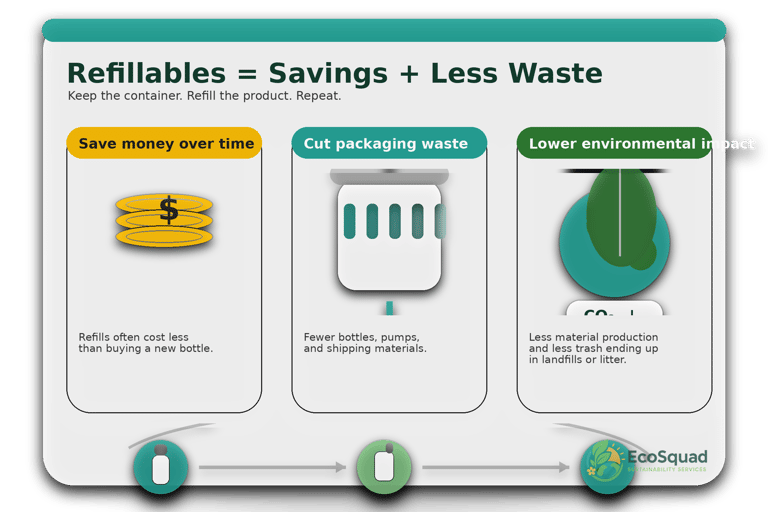
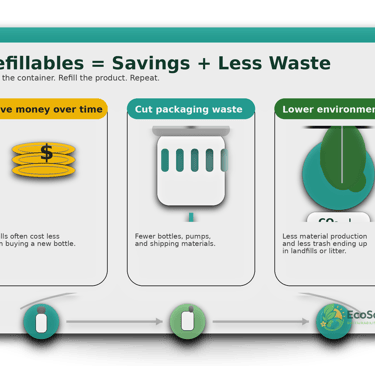
Every new plastic bottle, pump, cap, label, and shipping box requires raw materials and energy. When you refill a durable container, you spread that “manufacturing cost” over many uses.
Less landfill and litter
When packaging is avoided entirely, there’s nothing to recycle, landfill, or accidentally lose to the environment. UNEP’s work on plastics points to reducing single-use items and shifting toward reuse as key strategies to address plastic pollution.
Lower transportation emissions (often)
Many refill formats are concentrates, tablets, or bulk dispensing, which can reduce the amount of water and packaging shipped around. Ellen MacArthur Foundation highlights refills/concentrates as a way businesses can reduce packaging and transportation costs—and customers benefit too.
How refillables support sustainability.
Sustainability isn’t just “less trash.” It’s building habits and systems that are:
repeatable
resource-efficient
economically sensible
easy enough to stick with
Refill models can improve convenience (automatic reordering), reduce packaging, and keep materials in use longer—core “circular economy” principles.
Do refillables save money?
Often, yes—especially over time.
Refills can be cheaper per use because you’re not repeatedly paying for a brand-new bottle, fancy label, and oversized packaging. The Ellen MacArthur Foundation notes refills can be cheaper to buy and easier to carry/store than standard packaged products.
That said, the “starter” container might cost more upfront. Think of it like buying a good water bottle: you pay once, then coast.
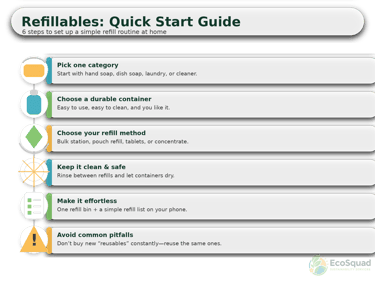
A step-by-step guide to getting started (without turning your kitchen into a crunchy museum)
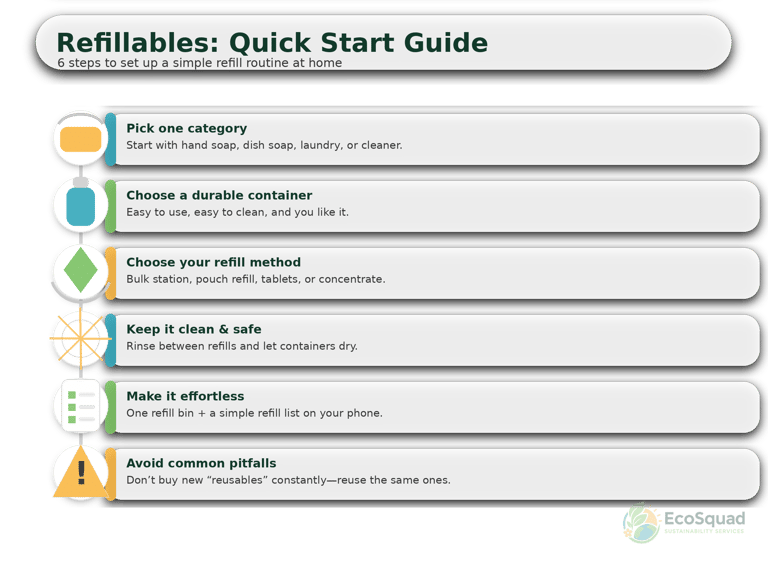
Step 1: Pick one category (don’t try to do everything)
Start where you use a lot:
Hand soap
Dish soap
Laundry detergent
All-purpose cleaner
Shampoo/body wash
Pantry staples (rice, oats, nuts, coffee)
Step 2: Choose a durable container you actually like using
Look for:
Easy to clean
Doesn’t leak
Pump/sprayer works well
Size fits where you’ll store it
Pro tip: “Pretty enough to leave out” = you’ll remember to use it.
Step 3: Choose your refill method
You’ve got options:
In-store bulk dispensers (bring your container, refill by weight/volume)
Refill pouches (less packaging than a rigid bottle)
Tablets or concentrates (add water at home)
Subscription refills (good for busy households)
The best option is the one you’ll stick with.
Step 4: Set up a simple cleaning routine (keep it hygienic)
Rinse containers between refills
Let them dry fully if you can
Don’t “top off forever” if it’s something that can get funky (soap is usually fine; food jars should be cleaned more carefully)
Step 5: Make it effortless
Keep a “refill list” on your phone
Store extra tablets/pouches in one bin
Refill before you’re completely out (nobody wants a half-washed head)
Step 6: Avoid refill “fails” (common pitfalls)
Refill packaging that’s heavier than the original: not a win.
Buying a new “reusable” container every month: defeats the point.
Complicated systems: if it’s annoying, it won’t last.
UNEP emphasizes that real progress comes from replacing single-use products with fit-for-purpose reusable alternatives—simple, practical systems.
Quick “starter pack” ideas (easy wins)
Hand soap: one nice dispenser + bulk refill
All-purpose cleaner: one spray bottle + tablet refills
Laundry detergent: concentrate refills or bulk
Water bottle / coffee cup: the classics (because they work)
How EcoSquad can help
If you want to reduce waste but don’t want to spend your Saturday researching refill stations and comparing refill formats, EcoSquad can help you:
Identify the easiest refill swaps for your household
Set up a simple, repeatable system (containers + storage + routines)
Reduce packaging waste without adding hassle
Sustainability works best when it’s frictionless.
Citation list
US EPA — Containers and Packaging: Product-Specific Data (2018 plastic packaging generation/recycling/landfilling; packaging recycling rate): https://www.epa.gov/facts-and-figures-about-materials-waste-and-recycling/containers-and-packaging-product-specific
OECD — Press release: Global plastic waste set to almost triple by 2060: https://www.oecd.org/en/about/news/press-releases/2022/06/global-plastic-waste-set-to-almost-triple-by-2060.html
OECD — Global Plastics Outlook (Policy Scenarios) PDF: https://www.oecd.org/content/dam/oecd/en/publications/support-materials/2022/02/global-plastics-outlook_a653d1c9/Global%20plastics%20outlook%20-%20policy%20scenarios.pdf
UNEP — Turning off the Tap: End plastic pollution, create a circular economy: https://www.unep.org/resources/turning-off-tap-end-plastic-pollution-create-circular-economy
UNEP — Single-use plastics: A roadmap for sustainability: https://www.unep.org/resources/report/single-use-plastics-roadmap-sustainability
Ellen MacArthur Foundation — Reuse: Rethinking Packaging (PDF): https://content.ellenmacarthurfoundation.org/m/4363f6da65122068/original/Reuse-Rethinking-packaging.pdf
UNEP — How to reduce the impacts of single-use plastic products (story): https://www.unep.org/news-and-stories/story/how-reduce-impacts-single-use-plastic-products
Contact
Get in touch for a greener tomorrow
Phone
© 2025. All rights reserved.
Join EcoSquad
Get tips and updates for greener living.